Trivex vs Polycarbonate Lenses (2026): Which Wins?
Trivex and polycarbonate are the two most common impact-resistant lens materials, and both show up constantly in prescription sunglasses and safety eyewear. The spec sheets make them look nearly interchangeable — but the real differences show up in optical clarity, how much a lens actually weighs once it is ground to your prescription, and what you pay. Here is what the numbers actually say.
|
Quick Verdict
Polycarbonate is the better default for most people: it is proven at high-velocity impact resistance, costs less, and its higher refractive index often keeps finished lenses thin and light even though the raw material is denser than Trivex. Trivex pulls ahead specifically on optical clarity (Abbe value 43 vs 30) and tensile strength, which matters more for rimless or drill-mounted frames and for wearers sensitive to edge distortion in stronger prescriptions — REKS charges roughly $70 more for Trivex on an identical frame, which is the real-world cost of that upgrade.
|
Trivex vs Polycarbonate: By the Numbers
Material properties compared side by side, sourced from published optical-lab technical data.
These aren’t marketing claims — the figures below come from HOYA Vision Care’s own published lens-material comparison, cross-checked against an independent optical lab’s data.
| Property | Trivex | Polycarbonate |
|---|---|---|
| Refractive index
Higher index bends light more, so polycarbonate lenses can be ground thinner for the same prescription.
|
1.530 | 1.586 |
| Abbe value (optical clarity)
Higher is better — less chromatic aberration (color fringing) at the lens edges.
|
43 | 30 |
| Specific gravity (density)
Lower density means Trivex material is lighter gram-for-gram, before accounting for lens thickness.
|
1.11 | 1.20 |
| Tensile strength
Resistance to cracking under stress, per HOYA’s published lab comparison.
|
61.2 kgf | 44.9 kgf |
| UV protection
Neither needs an added UV coating, unlike standard CR-39 plastic.
|
Blocks ~100% UV inherently | Blocks ~100% UV inherently |
| REKS Sling Blade Rx price (same frame)
Verified live direct from REKS, same frame, Single Vision through Progressive.
|
$195 – $295 | $125 – $225 |
Refractive index, Abbe value, specific gravity, and tensile strength figures are from HOYA Vision Care’s published polycarbonate-vs-Trivex technical comparison. REKS pricing verified directly with REKS on 2026-09-23.
The Weight Claim That’s More Complicated Than It Sounds
Trivex is less dense — but that doesn’t always mean a lighter lens.
Trivex has a lower specific gravity (1.11) than polycarbonate (1.20), which is usually the entire basis for calling Trivex “the lightest lens material available.” That’s true gram-for-gram of raw material. But finished lens weight depends on thickness as much as density, and polycarbonate’s higher refractive index (1.586 vs Trivex’s 1.530) means it bends light more efficiently — so a polycarbonate lens can often be ground thinner than a Trivex lens for the exact same prescription power. At low-to-moderate prescriptions, that thinner profile can offset or even reverse Trivex’s density advantage in practice. The density number alone doesn’t settle which lens actually feels lighter on your face — your specific prescription strength does.
Decision Guide: Which One Should You Pick?
|
|
What REKS Actually Charges for Each Material
Verified same-day direct from REKS, same Sling Blade frame.
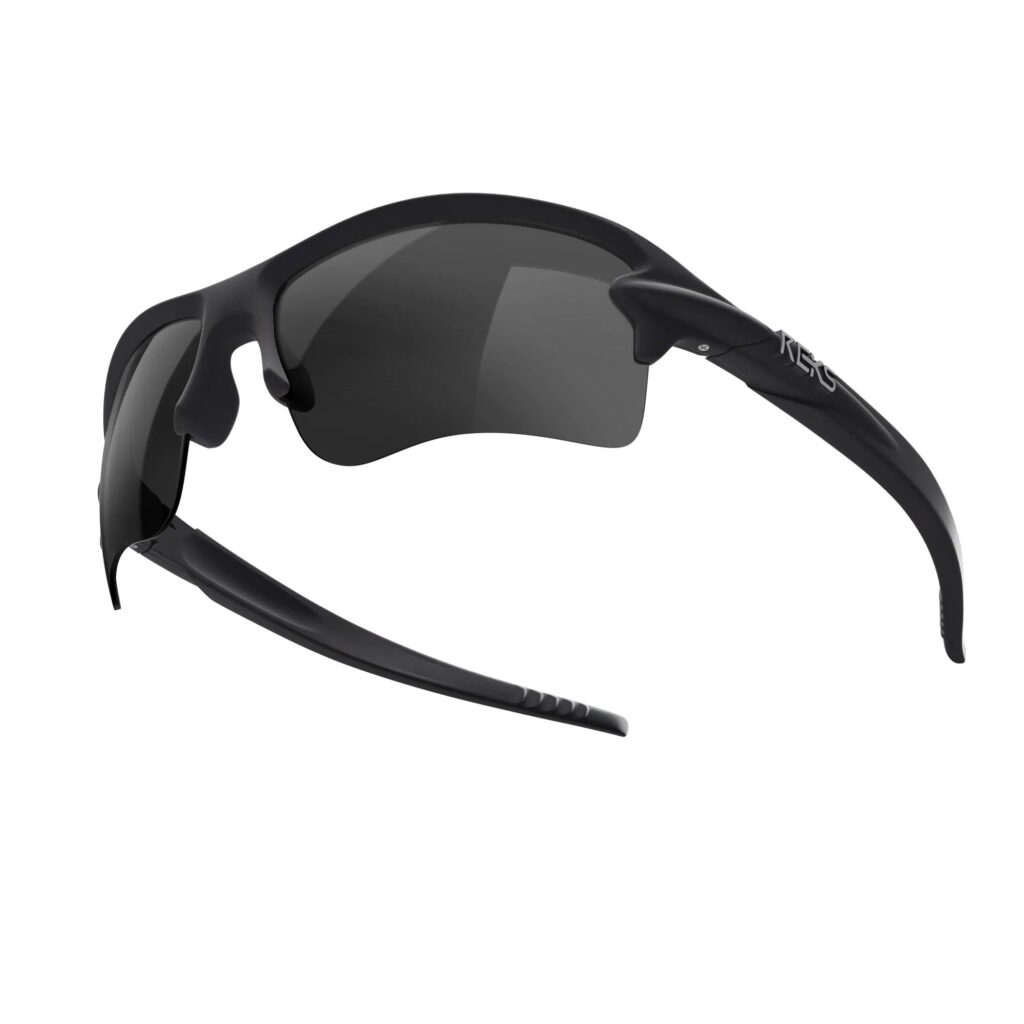
Rather than rely on generic industry pricing, we checked REKS’s own Sling Blade prescription sunglasses in both materials on the same frame. Polycarbonate runs $125 to $225 depending on lens type (Single Vision through Progressive), while Trivex runs $195 to $295 for the identical options — a roughly $70 premium at every tier. REKS also offers Trivex Color-Boosting lenses (a tinted variant of Trivex) starting around $195; see our REKS prescription sunglasses page for the full pricing ladder across every lens tier REKS offers.

REKS Sling Blade — Trivex vs Polycarbonate Rx
Same frame, two lens materials: Polycarbonate runs $125-$225, Trivex runs $195-$295 (Single Vision through Progressive).
From $125.00
|
|
Limited-Time Offer
10% OFF
Entire order, applied at checkout
🚚 Free Shipping & Returns💰 30-Day Money-Back Guarantee
|
Impact Resistance: The Surprising Lab Result
Two ways to measure ‘unbreakable,’ with different winners.
Durability isn’t a single number. On tensile strength — resistance to cracking under bending stress — Trivex outperforms polycarbonate (61.2 kgf vs 44.9 kgf in HOYA’s published test). But in a high-velocity impact test measuring the speed at which a lens fails, HOYA’s data showed polycarbonate withstanding impacts up to 100 m/s while Trivex failed in the 50-62 m/s range. Both materials comfortably pass the FDA drop-ball impact test and ANSI Z87.1 safety standard that everyday and safety eyewear are held to — the gap only shows up in higher-velocity lab testing that goes beyond what either standard requires. In practice, this is why polycarbonate remains the default material for dedicated safety glasses and high-impact sports eyewear, while Trivex is marketed more on optical quality and crack resistance in everyday and rimless frames. For REKS specifically, its frames themselves are covered by REKS’s own unbreakable-frame warranty regardless of which lens material you choose — see our fact-check on that claim in our REKS unbreakable sunglasses review.
Use Cases: Where Each Material Actually Makes Sense
Sports and safety eyewear: Polycarbonate’s track record in high-velocity impact testing and its lower cost make it the standard choice — it’s what most dedicated safety glasses and sport sunglasses ship with by default, REKS included.
Rimless and drill-mounted frames: Trivex’s higher tensile strength matters more here, since the lens material itself has to resist cracking around the small drilled holes that hold rimless temples and bridges in place.
Strong prescriptions: Trivex’s higher Abbe value (43 vs 30) reduces chromatic aberration — the color fringing some wearers notice at the edges of stronger lenses — more than polycarbonate does.
Budget-conscious everyday wear: Polycarbonate is the more economical option across REKS’s entire lens lineup and remains plenty durable and optically fine for low-to-moderate prescriptions.
FAQ: Trivex vs Polycarbonate
Tap a question to expand the answer.
Is Trivex better than polycarbonate?
Neither is universally “better” — Trivex has higher optical clarity (Abbe value 43 vs 30) and tensile strength, while polycarbonate has a stronger high-velocity impact-resistance track record and costs less. Which is better depends on your prescription, frame style, and budget.
Is Trivex lighter than polycarbonate?
By raw density, yes — Trivex’s specific gravity (1.11) is lower than polycarbonate’s (1.20). But polycarbonate’s higher refractive index often lets it be ground thinner for the same prescription, which can offset or reverse that density advantage in the finished lens, especially at lower prescription powers.
Do both materials block UV rays?
Yes — both Trivex and polycarbonate inherently block close to 100% of UV rays without needing an added coating, unlike standard CR-39 plastic lenses.
How much more does Trivex cost than polycarbonate?
On REKS’s Sling Blade frame specifically, Trivex runs about $70 more than polycarbonate at every lens tier (Single Vision through Progressive), verified directly with REKS.
Is there a current discount code for REKS lenses?
Yes — our REKS link applies a 10% off code automatically at checkout. See our REKS coupon code page for the current offer details.
Reader Verdict
For most people, polycarbonate is the sensible default — it’s the more tested material at high-velocity impact, it costs less, and unless your prescription is strong or your frame is rimless, you likely won’t notice the optical difference. Trivex earns its premium specifically for rimless frames, strong prescriptions where edge clarity matters, and wearers who’ve specifically noticed chromatic aberration before. For REKS’s full range of lens materials and finishes beyond these two, see our REKS review, our REKS sunglasses review, or our best REKS sunglasses roundup. Current offer details are on our REKS coupon code page.
|
Bottom Line
Explore REKS’s Lens Options
Polycarbonate or Trivex, on the same unbreakable REKS frame — compare pricing and pick the material that actually fits your prescription and budget.
Shop REKS Prescription Sunglasses → Material specs sourced from published optical-lab technical documentation; REKS pricing checked live direct from REKS in September 2026 and can change.
|
Affiliate Disclosure: This article contains affiliate links for REKS. If you purchase through one of our REKS links, ReviewDailyHub may earn a commission at no additional cost to you. Material specifications referenced here come from published third-party optical-lab and manufacturer technical documentation, not from REKS. Product details, prices and availability can change; verify current details directly with REKS before ordering.