.png)
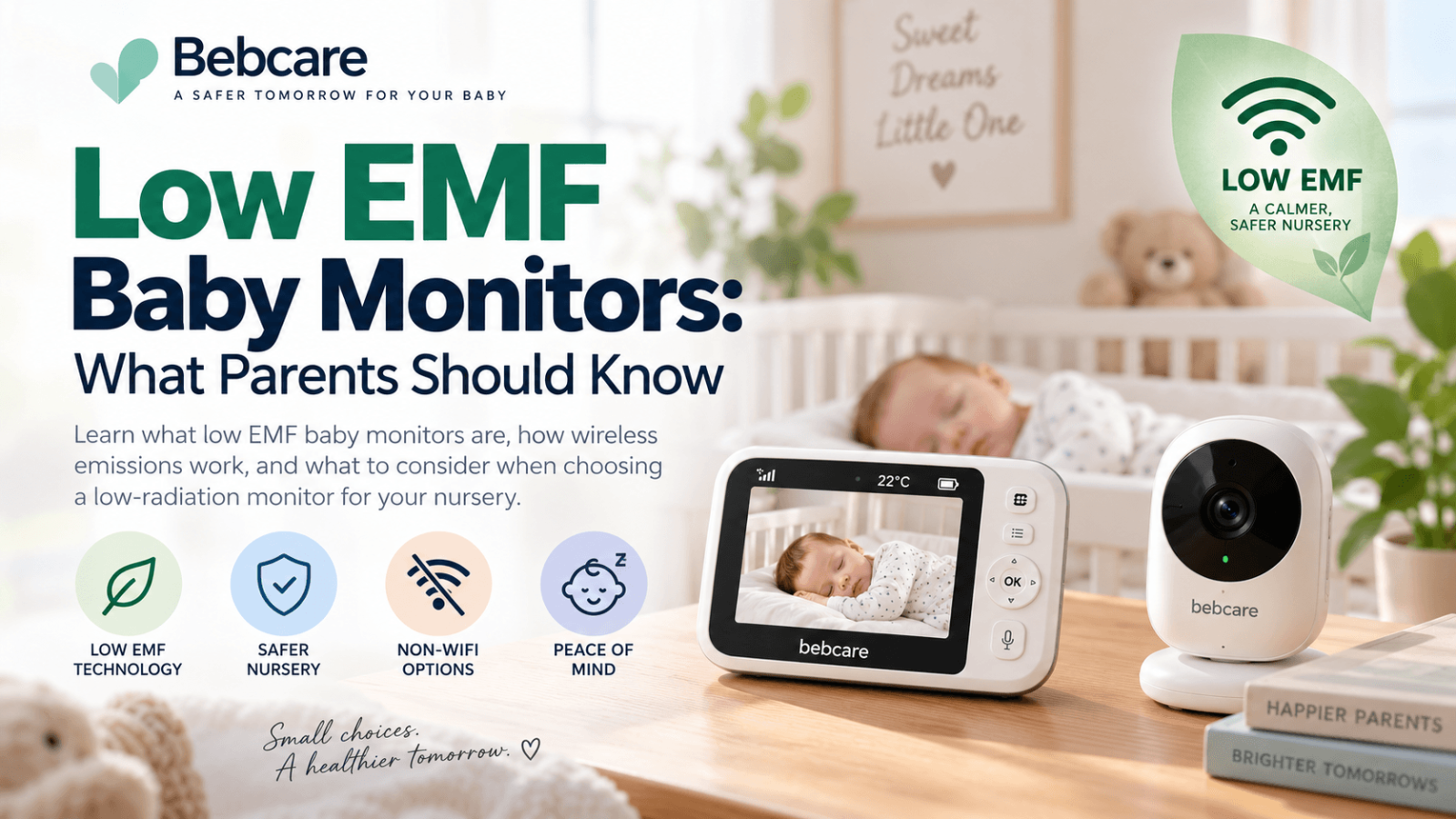
For many new parents, choosing a baby monitor isn't just about video quality or smartphone connectivity -- increasingly, parents also ask how much wireless energy a baby monitor emits. That's where low EMF baby monitors come in: monitors designed or marketed to reduce wireless emissions compared with conventional systems, whether through lower-power transmission, VOX/eco modes, or a dedicated non-WiFi connection.
One distinction matters up front: "low EMF" does not mean "zero health risk," and lower emissions shouldn't automatically be read as medically safer. This guide explains what "low EMF" actually means, what the current evidence says, and where Bebcare fits into the category -- see also our companion guide to the best baby monitor overall if you're still comparing models generally.
Affiliate disclosure: this page contains affiliate links. If you purchase through our links, we may earn a commission at no additional cost to you. Our recommendations are based on product features and information verified directly on the manufacturer's own site -- not on commission rates.
|
Quick Answer
If your priority is a low-emission baby monitor with a dedicated parent unit, the Bebcare Motion is one of the more interesting options: a non-WiFi video monitor with DSR ("Digital Safe Radio") technology that Bebcare advertises as reducing wireless EMF emissions by 94% compared with an average baby monitor. For audio-only, the Bebcare Hear takes the same low-emission approach into a simpler format. The exact meaning of "low EMF" matters more than the marketing label, though -- see below.
|
EMF stands for electromagnetic field -- produced by many everyday devices:
For baby monitors, the relevant part is usually radiofrequency (RF) energy from wireless communication -- different from ionizing radiation like X-rays. The National Cancer Institute notes this non-ionizing RF energy is too low to damage DNA directly, and that current evidence hasn't established dangerous health effects at ordinary consumer exposure levels.
This is where responsible buying advice matters. You'll find sites making strong claims that RF exposure causes neurological problems, cancer or developmental issues -- those claims shouldn't be treated as established medical fact.
US health agencies have long taken a reassuring position: FDA materials have stated the weight of scientific evidence hasn't linked cell-phone RF radiation with health problems, including in children, and the National Cancer Institute's own fact sheet states "the evidence to date suggests that cell phone use does not cause brain or other kinds of cancer in humans" because RF energy "is too low to damage DNA" the way ionizing radiation can. For balance: in 2011 the International Agency for Research on Cancer classified RF exposure as "possibly carcinogenic to humans" (Group 2B) based on limited evidence -- a cautious classification, not a confirmed hazard finding.
Worth knowing: in January 2026, HHS said it had removed several long-standing FDA webpages carrying that older blanket safety language and opened a new review of electromagnetic radiation and health research. That doesn't mean the science reversed -- FDA and CDC materials still describe no credible evidence of harm at consumer exposure levels -- but it does mean this is an active area of government review rather than a permanently settled question, and guidance could be updated as that review continues. None of this evidence is a clinical assessment of any specific baby monitor model, so it would be a stretch to conclude every monitor has identical exposure characteristics.
The sensible takeaway: if you prefer to minimize RF exposure as a precaution, choosing a lower-emission design and increasing distance from the crib are reasonable steps. But "low EMF" shouldn't be presented as proof that a product prevents disease or is medically safer.
There's no single feature that automatically makes a monitor "low EMF." Look at the actual transmission technology, operating modes, power levels and any manufacturer-provided measurements:
These details are far more useful than a "low radiation" badge on a product page.
Low EMF means emissions are reduced compared with some reference device or condition. "Zero" claims can be misleading if used broadly -- a powered electronic device produces electromagnetic fields in some form, and a wireless monitor still transmits RF energy while communicating.
Bebcare's own product-page footer copy, for example, describes its monitors as "the safest, lowest EMF, zero emissions, eco-friendly, sustainable baby monitor." When you see language like that, the more useful question is: what are the actual operating characteristics and measured emissions, not just the label.
Bebcare has made low-emission design central to its positioning, saying its monitors use DSR -- Digital Safe Radio -- technology to reduce wireless emissions. Its homepage currently advertises 94% reduced wireless EMF emissions compared with an average baby monitor; a separate page on its own site (a blog post on checking EMF safety at home) cites DSR reducing emissions "by 96% in some cases" -- a different figure for the same claim, so we'd treat the exact percentage as approximate rather than a single precise number either way. Either way, this is a manufacturer claim, not an independent medical conclusion -- we'd describe it as "Bebcare says its monitors emit up to ~94-96% less wireless EMF than an average baby monitor," never as "Bebcare is proven safer."
All 6 products below use Bebcare's DSR low-emission technology and are real, currently-live Bebcare products -- verified customer review counts are shown as a popularity signal since Bebcare doesn't publish an official "best-seller" label.
Save $50
 Bebcare Motion Digital Video Baby Monitor
$339.00 from $289.00
★★★★★ 2,099 reviews
Shop on Bebcare →
| Save $20
 Bebcare Hear Digital Audio Baby Monitor
$209.00 from $189.00
★★★★★ 877 reviews
Shop on Bebcare →
| |
Save $20
 Bebcare Mat Smart Breathing Sensor Mat
$169.00 from $149.00
★★★★★ 137 reviews
Shop on Bebcare →
| Save $99
 Bebcare Motion Digital Video Baby Monitor (Family Kit, 2 Cameras)
$658.00 from $559.00
No reviews yet
Shop on Bebcare →
|
The Bebcare Motion pairs low-emission positioning with a traditional dedicated-screen design: non-WiFi operation, a 4.3" "True Color" display, night vision, digital pan/tilt and zoom, two-way communication, temperature alerts, and support for multiple cameras with split-screen. Bebcare's own product page currently lists it at $289. Why it makes sense for low-EMF shoppers: you don't have to trade video features for a low-emission focus, and it doesn't need a home WiFi network to operate. |
If you don't need a camera, the Bebcare Hear takes the same low-emission approach into an audio-only format: dedicated parent/baby units, two-way communication, a temperature sensor, vibration mode, white-noise silencer and lullabies, with no WiFi, Bluetooth or cellular connection required. Current listed price is $189. Good fit if: you simply want to hear when your baby needs attention rather than run a constantly-connected video camera. |
A common misconception is "WiFi = high EMF, non-WiFi = low EMF" -- it's not that simple. Different wireless technologies, transmission powers and operating modes produce different exposure characteristics. A WiFi monitor such as the Bebcare iQ (1080p video, 360° pan/tilt, smartphone access) can still be marketed as low-emission. The better question isn't "does this have WiFi?" -- it's "how does this specific monitor transmit, at what power, under what conditions?"
If minimizing connected technologies in the nursery is your main goal, non-WiFi may be attractive. If remote access matters, WiFi may be worth the trade-off. See our full WiFi vs. Non-WiFi Baby Monitor comparison.
Wireless
|
Placement
|
Documentation
|
Monitoring needs
|
If you're also researching movement or breathing-related nursery accessories, see our Baby Breathing Monitor guide and Bebcare Breathing Sensor Mat review -- treated strictly as consumer monitoring aids, never as SIDS-prevention or medical devices.
For many parents, yes -- mainly as a preference rather than a medical necessity. If your existing monitor already meets your needs, nothing here suggests you need to replace it just because it isn't marketed as "low EMF." But if you're buying new and want less wireless connectivity, a non-WiFi design, a dedicated parent unit, or more physical distance between electronics and the crib, a low-emission monitor is a reasonable choice -- and this is where Bebcare becomes particularly interesting.
|
Our Verdict
Bebcare Motion -- our pick for a low-EMF video monitor: video, night vision, temperature alerts and multi-camera support without WiFi, paired with Bebcare's DSR low-emission positioning. Bebcare Hear is the simpler audio-only alternative. If checking your baby from outside the home matters, the Bebcare iQ (WiFi/smartphone access) is the more appropriate direction.
|
For the full brand-level picture, see our Bebcare review.
Generally, a monitor designed or marketed to produce lower electromagnetic emissions than a specified comparison device or mode. There's no single universal definition that makes every product labeled "low EMF" equivalent.
It would be inaccurate to say a "low EMF" label alone proves a monitor is medically safer. Government health agencies have long said available evidence doesn't link ordinary RF exposure with health problems, including in children -- though this is an area under renewed government review as of 2026 (see above), so we'd avoid treating it as permanently settled either way.
There isn't enough standardized, independently-tested data across manufacturers to name one universal lowest-EMF model. Compare actual transmission technology, operating modes and any measured emissions data rather than relying on marketing labels alone.
Yes -- Bebcare specifically markets its monitors as low-emission products using DSR technology, currently advertising a 94% reduction in wireless EMF emissions compared with an average baby monitor on its homepage (a separate page on its own site cites 96% "in some cases"). These are manufacturer claims, not independently verified figures.
Not automatically. Non-WiFi and WiFi are different communication methods, but actual emissions depend on the specific device, transmission power and operating mode.
Follow the manufacturer's instructions. Bebcare's own nursery guidance recommends placing the monitor at least three feet from the crib.
No. RF energy from wireless devices is non-ionizing radiation, fundamentally different from ionizing radiation such as X-rays, which carries enough energy to damage DNA directly.
No. A consumer baby monitor should never be treated as SIDS prevention, and it does not replace safe-sleep practices or adult supervision. Bebcare itself states its products are not medical devices.
|
Ready to Explore a Low-Emission Monitor?
Don't Let Marketing Labels Replace the Fundamentals
Secure installation, keeping electronics and cables away from the baby's sleep space, safe-sleep practices, and a monitor that fits how your family actually lives matter more than any single label. Our affiliate dashboard currently shows 15% off selected collections with a $140 minimum purchase. Full offer details: Bebcare coupon code. Check Bebcare Motion & Current Offer →Offer terms and availability may change. Verified live as of September 2026. |
Affiliate Disclosure: This page contains affiliate links. If you purchase through one of our links, ReviewDailyHub may earn a commission at no additional cost to you. Bebcare sets its own discount terms and can change or end this offer at any time; always confirm the final price and terms at checkout on bebcare.com.

