.png)
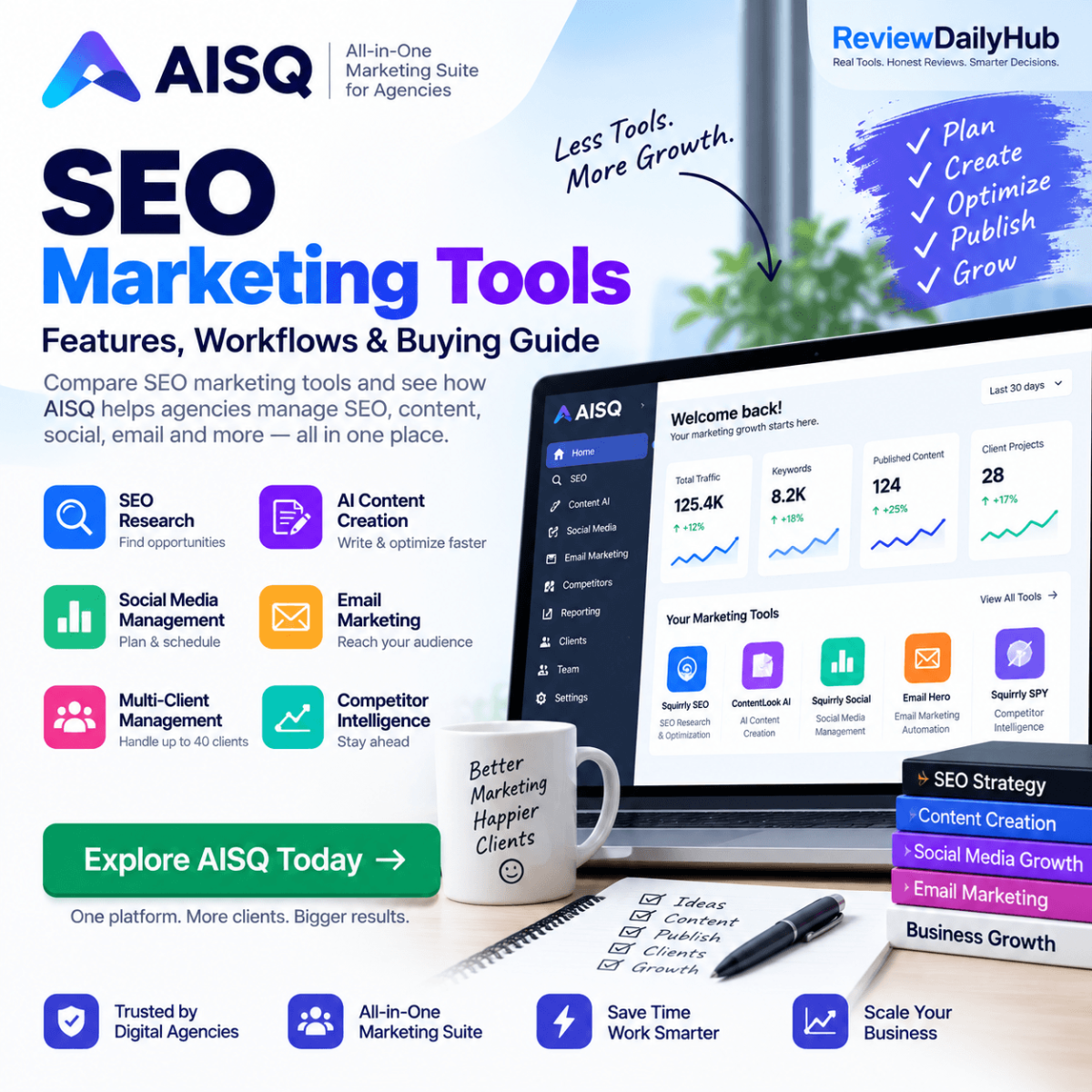
Choosing the right SEO marketing tools is no longer simply about finding a keyword research platform. Modern marketing teams often need to manage keyword research, SEO optimization, content creation, publishing, social media, email campaigns, competitor research, analytics and reporting at the same time.
That creates a familiar problem: the more services an agency offers, the more software subscriptions it may need to manage. The result can be a fragmented workflow where one tool handles SEO, another handles social media, another handles email, another handles content and another handles reporting.
This guide explains what to look for in SEO marketing tools, how different categories fit together, and where an agency-focused platform such as AISQ Meteor can fit into the broader marketing workflow.
SEO marketing tools are software platforms that help businesses and agencies research, plan, execute, optimize and measure search-driven marketing activities. Traditional SEO tools tend to focus on areas such as:
However, SEO is increasingly connected to other marketing activities. A content strategy may involve:
Keyword Research | → | Content Planning | → | Content Creation | → | SEO Optimization | → | Publishing | → | Social Distribution | → | Email Distribution | → | Performance Tracking |
Because of that, agencies may look beyond a single SEO application and evaluate broader SEO marketing software or integrated marketing platforms.
There isn't one universal tool stack that works for every company. The right choice depends on factors such as:
A useful evaluation framework starts with the following areas.
|
1. SEO Research
A good SEO workflow starts with research. Important capabilities can include keyword research, search-volume analysis, SERP research, search-intent analysis, competitor research, content opportunity discovery and ranking analysis. For agencies, research becomes even more important because the process needs to be repeatable across multiple clients. The goal isn't simply to collect thousands of keywords — it's to identify the topics, search opportunities and content priorities that can actually support the client's marketing strategy.
|
|
2. SEO Optimization
SEO marketing tools should also help turn research into optimized pages. Depending on the platform, this may include on-page SEO recommendations, content optimization, technical SEO checks, internal linking, SERP monitoring, website audits, SEO scoring and optimization workflows. For an agency, centralized optimization can reduce the need to move information manually between several applications.
|
|
3. AI-Assisted Content Workflows
AI has changed the way agencies approach content production, but generating text is only one part of the workflow. A scalable system needs to consider research, planning, creation, optimization, approval, publishing and distribution as one chain. AISQ's current positioning focuses on combining AI-assisted marketing execution with human approval — its main site describes workflows covering SEO, content, social media and email, while the Meteor product is positioned specifically for agencies. For professional agency workflows, automation should not necessarily mean publishing everything without review; a useful system should allow teams to maintain control over what is approved and published.
|
|
4. Content Publishing and Distribution
SEO traffic doesn't exist in isolation. After creating an article, agencies may want to distribute it through social media, email, repurposed content, client channels and other owned media. AISQ Meteor currently groups several marketing functions into one agency-oriented stack, including SEO, social, AI-assisted content, email, competitive intelligence, website insights and other marketing capabilities — which makes the platform relevant to a broader discussion about SEO marketing software, rather than just traditional SEO software.
|
|
5. Competitor Intelligence
Competitor research is another important part of SEO marketing. Agencies may need to understand which competitors are visible in search, what content they publish, what topics they target, which pages generate opportunities, and how a client's positioning compares with competitors. AISQ Meteor includes Squirrly SPY, which AISQ describes as a competitive-intelligence reporting tool for agency client work. For an agency, competitor intelligence can therefore become part of both SEO strategy and client reporting.
|
|
6. Client Management and Agency Workflows
This is where evaluating SEO tools from an agency perspective becomes different from evaluating them as an individual website owner. An agency may need to manage multiple websites, multiple clients, different brand identities, different content workflows, client approvals, reporting, publishing schedules and different marketing channels. AISQ positions Meteor as an agency-focused system with capacity for up to 40 client accounts, together with agency-oriented controls and workflows — which makes the number of client accounts and workflow controls important questions when comparing SEO marketing tools.
|
|
Evaluating SEO marketing tools for an agency workflow?
Explore AISQ Meteor →
|
A traditional SEO platform may concentrate heavily on search. An SEO marketing software platform may attempt to connect SEO with other marketing functions. Here's a simplified comparison:
| Capability | Traditional SEO Tool | Broader SEO Marketing Platform |
| Keyword research | ✓ | ✓ |
| SEO audits | ✓ | ✓ |
| Rank tracking | ✓ | ✓ |
| Content optimization | ✓ | ✓ |
| AI content workflows | Sometimes | Often |
| Social distribution | Limited / separate | May be integrated |
| Email marketing | Usually separate | May be integrated |
| Competitor intelligence | ✓ | ✓ |
| Client workflows | Varies | Agency-focused platforms may include it |
| Multi-client management | Varies | Important agency feature |
| Marketing automation | Limited | Broader platforms may include it |
The right option depends on whether your priority is a specialized SEO workflow or a broader marketing system.
AISQ Meteor is positioned as an agency-focused marketing stack rather than a single-purpose SEO application. According to AISQ's current Meteor materials, the $400/month plan includes 10 tools and supports up to 40 client accounts. The stack includes products such as Squirrly SEO, Squirrly Social, WP Ghost, Next Level Marketing AI, Email Hero, ContentLook AI, Squirrly SPY, Education Cloud Business, Product Perfect Feed and Starbox PRO.
The broad functional areas AISQ groups these tools into cover SEO, AI-assisted content, distribution and growth/insights — connecting research, optimization, content, distribution and insights rather than managing each activity entirely separately.
Who might consider this approach? It can be particularly relevant to:
AISQ's own digital-presence materials specifically identify agencies, SEO agencies, web agencies and consultants managing multiple brands as target users for Meteor.
The current AISQ Meteor materials identify the following ten components:
|
| ||
|
| ||
|
| ||
|
| ||
|
|
Instead of treating every tool as a separate task, an agency could structure its workflow around a sequence such as:
Research | → | Strategy | → | Creation | → | Optimization | → | Approval | → | Distribution | → | Measurement |
| Research | Identify search opportunities, competitors, content gaps, client questions and existing performance. |
| Strategy | Turn research into keyword clusters, content priorities, SEO campaigns, content calendars and client deliverables. |
| Creation | Develop blog content, social content, email content and supporting marketing assets. |
| Optimization | Review search intent, on-page SEO, content quality, internal linking, metadata and brand consistency. |
| Approval | Human review remains important before publishing. |
| Distribution | Publish and distribute through the website, social channels, email and other owned channels. |
| Measurement | Track search visibility, traffic, content performance, engagement and client outcomes. |
This type of connected workflow is central to AISQ's current positioning.
Pricing varies significantly depending on the platform and the number of capabilities included. A common mistake is comparing only the subscription price of one SEO application. For agencies, the actual software cost can involve multiple subscriptions: SEO + Content + Social + Email + Analytics + Competitor Research + Security + Reporting.
AISQ currently lists Meteor at $400/month and describes it as a single subscription covering its agency stack, with up to 40 client accounts.
The important comparison is therefore not simply:
"Which SEO tool is cheapest?"
A better question is:
"What does the complete marketing workflow cost me to operate?"
AISQ's current Meteor page lists the agency plan at $400 USD/month. The page also specifies 40 client slots for the plan and describes additional Meteor subscriptions as a way to scale beyond that capacity.
Pricing and included capabilities can change, so readers should verify the current offer before purchasing. For a full plan-by-plan breakdown, see AISQ pricing.
|
Want the current AISQ Meteor plan details?
Check the Current AISQ Offer →
|
An integrated platform can make sense when an agency is dealing with several of these problems:
|
Too many subscriptions
Different marketing activities require different software products.
|
|
Too much manual work
Information has to be copied from one application to another.
|
|
Multiple clients
Every workflow needs to be repeated across several websites.
|
|
Growing content requirements
The agency needs more output without simply adding more manual tasks.
|
|
Client approval requirements
AI-generated or automated work still needs human review before publication.
|
|
Increasing operational complexity
The problem becomes less about finding another tool and more about coordinating the entire system.
|
AISQ's agency positioning is specifically built around this type of multi-client workflow.
An integrated platform isn't automatically necessary. A specialized SEO tool may be sufficient when:
The decision should therefore be based on workflow requirements rather than the number of features alone.
Before choosing an SEO marketing platform, consider these questions:
|
| ||
|
| ||
|
|
The best way to evaluate SEO marketing tools is to look beyond keyword research alone. For a small website, a specialized SEO application may provide everything needed. For an agency managing multiple clients, the bigger challenge can be connecting:
SEO | → | Content | → | Social | → | Email | → | Competitor Intelligence | → | Reporting | → | Client Delivery |
AISQ Meteor takes an integrated approach to that workflow, combining multiple AISQ tools into an agency-oriented stack. Its current plan is listed at $400/month with capacity for up to 40 client accounts.
For agencies considering this model, the key question isn't simply how many features a platform has — it's whether those capabilities fit the way the agency actually researches, creates, approves, publishes and measures marketing work.
|
Agency Marketing Stack
Explore AISQ Meteor
If you're evaluating an integrated SEO marketing software stack for agency workflows, you can review the current AISQ Meteor offering directly.
Explore AISQ Meteor →
Pricing and features verified as of September 2026 — confirm current details directly with AISQ before subscribing.
|
SEO marketing tools are software products used to support SEO research, optimization, content workflows, performance tracking and related marketing activities.
SEO tools can focus on specific search functions such as keyword research or SEO audits. SEO marketing software may combine SEO with content, social, email, automation, analytics or other marketing workflows.
AISQ Meteor is positioned by AISQ as an agency-focused marketing stack rather than a standalone SEO tool. Its current stack combines SEO, AI content, social, email, competitive intelligence and other marketing capabilities — see our AISQ Meteor review for the full breakdown.
AISQ's current Meteor page lists the plan at $400 USD/month with up to 40 client accounts. Verify the current offer before purchasing because pricing and plan details can change.
AISQ positions Meteor for agencies and professionals managing multiple client companies, including marketing agencies, SEO agencies, web agencies and consultants — see AISQ for agencies for agency-specific use cases.
Related reading: AI SEO tools for a closer look at AI-driven platforms, SEO marketing software for a software-focused comparison, and AISQ features for a full breakdown of what's included in the Meteor stack.
Affiliate Disclosure: This article contains affiliate links. If you sign up through one of our links, ReviewDailyHub may earn a commission at no additional cost to you. Features and plan availability can change; verify current details directly with AISQ before subscribing. Information is accurate as of publishing (September 2026).